
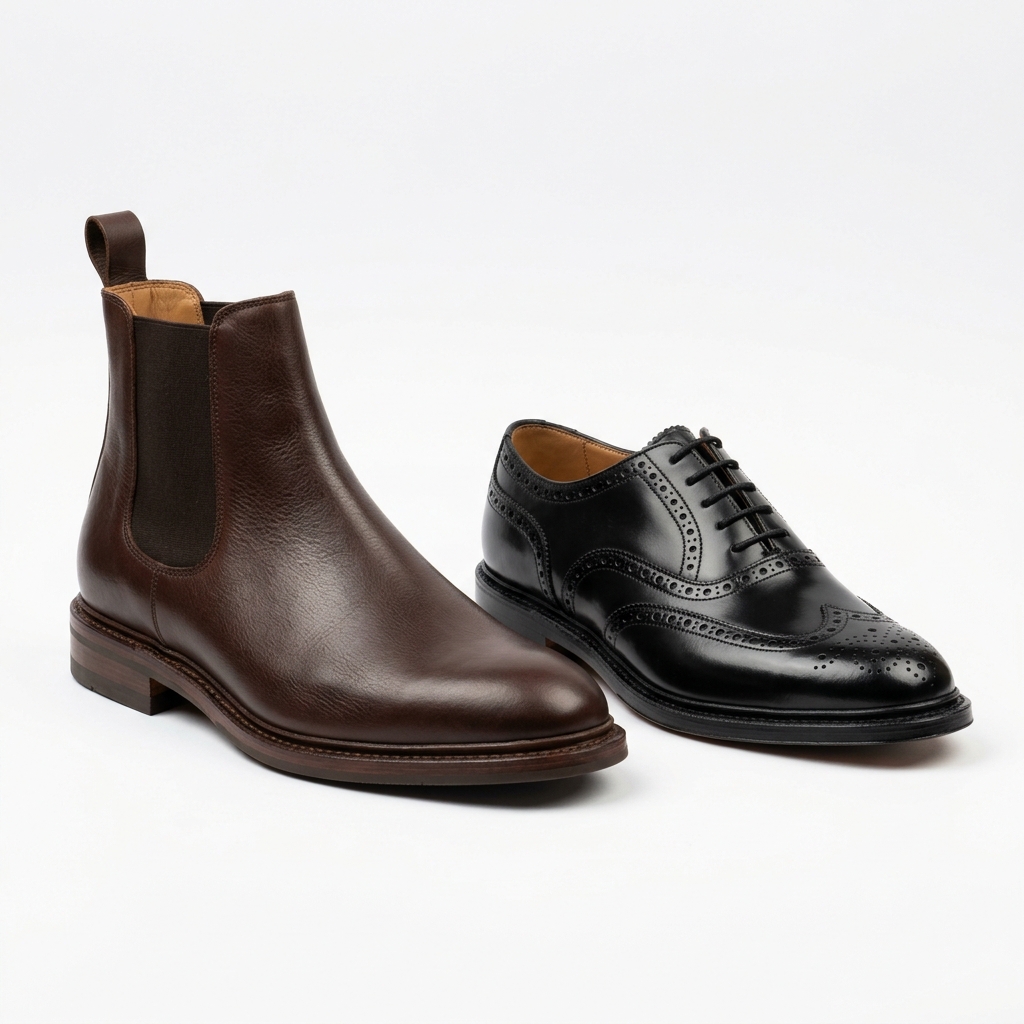
From the paved cobbles of Mayfair to the rainy avenues of Edinburgh, fine leather footwear anchors British menswear and womenswear with quiet authority. Yet, when investing in artisan footwear, two historic designs dominate the classic English rotation: the elastic-sided Chelsea Boot and the wingtip perforated Brogue. Both boast centuries of British royal and rural heritage, but each serves distinct sartorial and practical purposes.
In this footwear masterclass, the leather specialists at DA Supermart Ltd dissect shoe construction—specifically why Goodyear-welting represents the pinnacle of footwear engineering—and provide clear guidelines on when to wear Chelsea boots versus classic brogues.
1. The Gold Standard: What is Goodyear-Welted Construction?
Most commercial high-street shoes are cemented (glued) together with cheap synthetic adhesives. After 12 to 18 months of moisture exposure, the glue dissolves and the sole detaches, rendering the shoe destined for landfill. In contrast, Goodyear-welting is a time-honoured British bench-made method:
- The Welting Rib: A strip of vegetable-tanned leather (the welt) is machine-stitched directly to both the upper hide and the internal insole rib.
- Cork Filling Bed: The cavity between the insole and outsole is filled with granulated natural cork. Over 30 days of wear, your foot heat and weight compress the cork, creating an exact, bespoke imprint of your foot arch.
- Infinite Resolability: Because the outer sole is stitched to the welt rather than the upper leather, a skilled cobbler can remove and replace worn soles indefinitely without damaging the upper. A Goodyear-welted pair easily lasts 20 to 30 years.
2. Chelsea Boots vs. Brogues: Side-by-Side Comparison
| Feature | The Leather Chelsea Boot | The Classic Wingtip Brogue |
|---|---|---|
| Origin | Victorian Era (Patented by J. Sparkes-Hall for Queen Victoria) | Scottish & Irish Highlands (Drainage holes for bog trekking) |
| Fastening | Slip-on with heavy elastic side gussets & pull tabs | Laced Oxford or Derby system with punched perforations |
| Weather Resilience | Superior protection over ankles against rain and snow | Exquisite formal style; lower ankle exposure |
| Dress Code Versatility | Flawless from distressed raw denim to sharp tailored suits | Traditional business suits, tweed sport coats, smart chinos |
Leather Footwear Care in British Rain
Never wear fine leather shoes on consecutive days. Leather soles absorb up to 30ml of foot perspiration and street moisture during a full day of wear. Inserting unvarnished cedar wood shoe trees immediately after taking them off absorbs moisture, prevents toe-spring curling, and repels foot odours naturally.
3. Styling Blueprints for the Modern Wardrobe
The Chelsea Boot Uniform
Pair polished black or dark chocolate Chelsea boots with a black leather biker jacket, slim dark indigo selvedge denim, and a grey cashmere crewneck. The clean, laceless vamp of the boot elongates the leg line effortlessly.
The Country Brogue Heritage Ensemble
Pair rich oxblood or cognac wingtip brogues with heavy tweed or corduroy trousers, a cable-knit cardigan, and a brown leather trench coat or peacoat for timeless British country estate elegance.
4. Frequently Asked Questions (FAQs)
Can you wear Chelsea boots with a two-piece formal suit?
Yes. A sleek, plain-toe black calfskin Chelsea boot with a slim leather sole looks remarkably sharp with tailored navy or charcoal wool suits.
How do you stop leather soles from slipping on wet UK pavements?
Have your local cobbler apply a thin, durable rubber top-sole (such as a Vibram or Dainite rubber half-sole) over the leather welt. This preserves the elegance of the shoe while providing maximum traction on wet pavements.
Pair your fine footwear with handcrafted British outerwear from the DA Supermart Ltd Collection—100% genuine hides with Free UK Delivery and 30-Day Returns.
3. The Essential Break-In Guide for British Leather Footwear
Because genuine Goodyear-welted shoes and boots utilize thick vegetable-tanned leather insoles and robust full-grain uppers, they require a patient break-in phase before achieving bespoke comfort:
- The 2-Hour Rule: For the first 5 to 7 days, wear your new Chelsea boots or brogues indoors on carpeted floors for only 2 to 3 hours at a time. This allows the stiff leather uppers to gently warm up and mold to your ankle and metatarsal joints without causing painful friction blisters.
- Wear Thick Merino Wool Socks: Cushioned natural wool socks provide essential cushioning while absorbing moisture during the early break-in period.
- Condition the Flex Points: Apply a small dab of natural leather conditioner across the vamp (the crease line above the toes) before your first outing. Conditioning softens the fibers, ensuring the leather creases cleanly rather than cracking.
4. Resoling Economics: Why Bench-Made Footwear Saves You Thousands
A standard pair of glued high-street boots costing £80 must be discarded the moment the synthetic sole wears smooth or detaches. Over 10 years, buying a new pair every autumn costs £800+. Conversely, a Goodyear-welted pair from a reputable British shoemaker costing £180–£250 can be resoled by any local cobbler 4 to 6 times for approximately £40. Over 15 to 20 years, your total footwear cost drops significantly while you enjoy the comfort of shoes molded perfectly to your feet.
5. Heritage Cobbler Care: The Art of the Mirror Shine
To achieve a mirror-like military shine on your Goodyear-welted toe caps, British footwear purists practice the time-honored technique of spit-shining. Using a soft cotton rag wrapped around two fingers, apply a minuscule dab of carnauba wax polish followed by a single droplet of cold water. Rub in tiny, gentle circular motions across the toe cap for five minutes until the surface transforms into a glass-like optical mirror that commands admiration.